Konstantin Filippou: The chef who doesn’t want to be a rock star


A few weeks after Konstantin Filippou’s visit to Athens for the Athens Gastronomic Forum, I found myself in Vienna as his guest, in the city where he has built both his life and his career. The purpose of the trip was to visit his two Michelin-starred namesake restaurant, as well as his two other culinary ventures, Mama Konstantina and Boufes.
After a deeply satisfying meal at Mama Konstantina, we sat down for a conversation that quickly moved away from the usual questions about ingredients and technique.
Konstantin Filippou grew up, as he puts it, like an “Austrian Mediterranean kid”. He explains that many young chefs spend years trying to find their identity. “Sometimes they go very far, because they chase achievements and look for something that may have nothing to do with where they grew up.” In his case, he feels fortunate. “For me, it was never a question. I always knew where I came from.”

His background comes alive through memories that have stayed with him since childhood. “On one plate we had schnitzel, on the other tzatziki,” he says with a laugh. He avoids the word fusion, believing it is often misunderstood. He prefers to say that he carries two hearts within him. When he is in Greece, he feels deeply Greek. When he is in Vienna, he feels Austrian.
For me, it came as a pleasant surprise that there is no Greek music playing in his restaurants. It seems he has consciously avoided the easy choices often used to underline a chef’s heritage. What interests him more is the way Austrian and Greek culture shaped him as a person, and that is reflected in the feeling a meal leaves behind, not necessarily in the ingredients he uses.
Vienna is a city with a vast musical heritage, from its philharmonic tradition to the structure of its architecture. I ask him whether that kind of cultural discipline has influenced the precision of his cuisine. He often goes to concerts and has close friends who are musicians. “When I go to a concert, I sit down, sometimes I close my eyes, and I wait for emotion to overwhelm me.” For him, perfection is the result of constant practice. “When you aim for perfection, you have to practise a lot. You have to become a master at what you do.”

He sees common ground between a cook and a musician, especially in mentality. His musician friends, he says, are extremely sensitive and able to perceive shades that can easily go unnoticed in everyday life. Conversations with them have influenced the way he sees his restaurant as a space for emotional experience.
When it comes to music in restaurants, his position is clear. “Music in restaurants is very difficult.” Many of his friends complain about acoustics and volume, since so many places fail to invest properly in sound. He dislikes loud music that drowns out conversation, and he has no interest in obvious crowd-pleasing hits chosen simply so guests can sing along. “Music should complete the atmosphere,” he tells me. At the same time, his kitchen remains a place of complete silence. “For me, the kitchen is a safe space. It is a place of quiet.” His life is already intense enough, and he does not need music to push him forward. “I already have the energy. I only need something to calm me down,” he says with a laugh.
Konstantin speaks with real affection for the night. He likes walking through the city after midnight, when everything is quiet. “You have time to breathe, to think, to feel your own rhythm.” That overall rhythm is what he wants to stay in the memory of his guests.
He places enormous importance on the quality of service. “No one talks about service anymore,” he says, stressing that in great restaurants service should feel like choreography. “It is magic.” He has no desire to step into the dining room and explain every dish himself. He prefers an approach that combines old-school values with a contemporary lightness, and for him the experience is only complete when elegance is present.
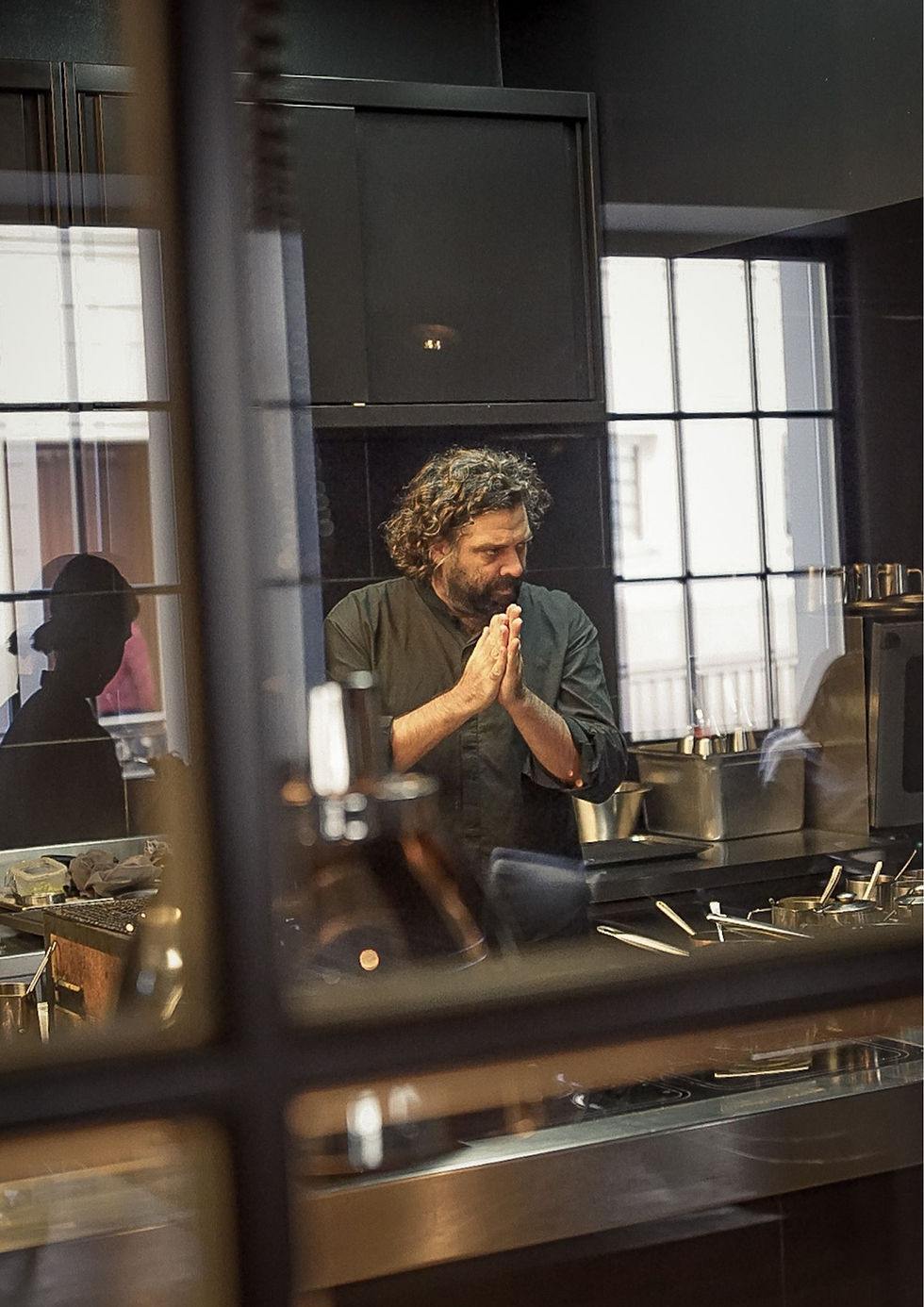
When I ask whether chefs are the new rock stars, he smiles and immediately says that the term needs redefining today. “Some are. But most are hard-working people.” He comments with humour that many chefs now drink matcha, work out and work fewer days, which does not exactly fit the image of a rock star, or at least not the one we used to know. For him, the real question is whether you do what you do out of love or out of a need for recognition. “If you don’t feel it anymore, you should stop.”
Konstantin respects those who remain at a high level for decades, but he himself is always searching for change. “I like change. It’s my biggest problem.” He is already thinking about the next decade and would like to try something different, perhaps in another field. “The hardest thing of all is moving forward together with your people. Everyone has to want to follow.”
Toward the end of the conversation, I ask him which artist he would choose if he had the chance to collaborate on a tasting menu. Konstantin answers almost instantly: the sculptor Richard Nonas, who is no longer alive. He describes a three-hour conversation they once had about minimalism and materials, an encounter that deeply influenced him as a person, while showing me photographs on his phone of the works by Nonas that he keeps at home.
The story comes full circle with an unexpected guest. Mick Jagger once visited his restaurant incognito and, as Konstantin tells me, was exceptionally polite. He stayed later than every other guest and tasted the entire menu. Although Konstantin has enormous respect for the privacy of his diners, on that occasion he went out to speak with him. The photograph they took together was, as he described it, a moment of mutual respect and appreciation, far removed from the logic of a simple fan encounter.

At some point, the recording of our conversation stopped. He then led me to a large table in front of the open kitchen, while his wife Manuela joined us. He opened a bottle of red wine and for the rest of the time we spoke about the impression Greece’s gastronomic rise over the past five years had made on him, about our restaurant preferences, while in between he played with his daughter Athena, who wandered through the restaurant holding a saucepan


Comments